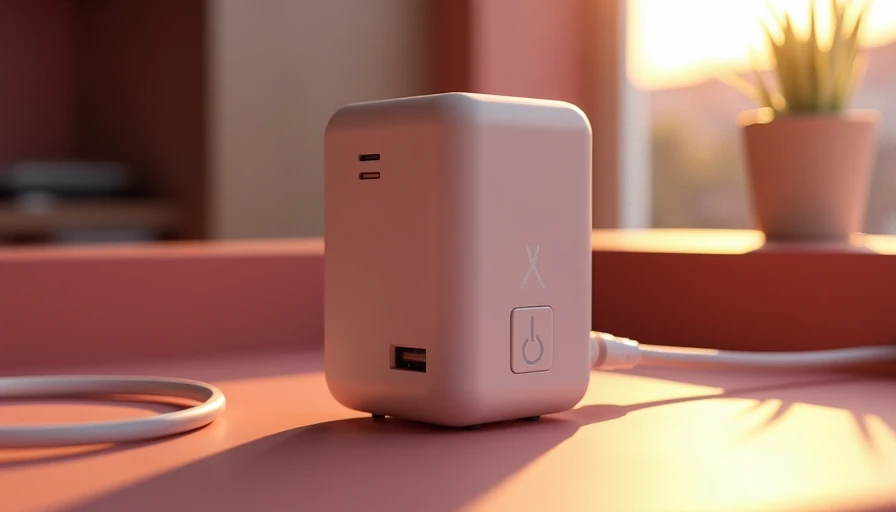
The phrase Fujifilm 15W AC adapter with USB-C port sounds simple, but it can describe several different buying situations. You might need a replacement wall charger, a second adapter for travel, or a compact power source for charging a Fujifilm camera through its USB-C socket. The important detail is not the wattage printed on the box. It is whether the adapter, cable, and camera agree on how power should be delivered.
I have learned to slow down at this point. Camera accessories often look interchangeable when their electrical behavior is not. A careful check before ordering can prevent a dead battery, a slow charge, or a pile of accessories that only works in one narrow arrangement. The best camera is the one you understand, and the same principle applies to the power around it.
What the 15W rating actually tells you
Fifteen watts describes the maximum power the adapter is designed to provide under its supported conditions. It does not mean your camera will always draw 15 watts. A camera may request less power, especially when the battery is nearly full, the body is asleep, or the charging circuit limits input for temperature and battery-protection reasons.
For a rough example, an adapter rated at 5 volts and 3 amps can reach 15 watts. That is a common USB power combination, but the label alone does not prove that every USB-C charging mode is supported. Some adapters advertise a USB-C-shaped connector while using a basic output profile. Others support additional USB Power Delivery profiles that a particular camera may or may not use.
That is why the Fujifilm 15W AC adapter with USB-C port should be treated as a specification to verify, not an automatic compatibility guarantee. Look for the output voltage, amperage, and any stated USB-PD information. If a listing only says “fast charger” without showing electrical details, I would move on.

USB-C is a connector, not a promise
USB-C identifies the shape of the port. It does not, by itself, tell you whether the device supports charging, data transfer, video output, or high-wattage power. This distinction matters with Fujifilm cameras because USB-C ports can serve several functions depending on the model and the setting.
Some recent bodies, including models such as the X-T5, X-S20, and X100VI, support in-camera battery charging through USB-C. That does not mean every older Fujifilm body does the same thing. Some cameras need a dedicated external battery charger, while others use USB connections mainly for data or tethering. Confirm the manual for your exact model before relying on the Fujifilm 15W AC adapter with USB-C port as your only charging method.
The cable is part of the chain, too. A USB-C cable with a USB-C plug at both ends is usually the most straightforward match for a USB-C wall adapter. A USB-A-to-USB-C cable can work with a suitable older charger, but it may support a different charging profile. Avoid ultra-thin, unbranded cables for paid work or travel. A cable that intermittently disconnects can leave a battery apparently charged when it is not.
Will 15 watts charge a Fujifilm battery quickly?
Usually, 15 watts is a reasonable everyday charging capacity for a mirrorless camera, but “quickly” depends on more than the adapter. Battery size, camera temperature, the charge level, and whether the camera is being used while connected all affect the result. Charging while recording video or powering accessories can reduce the energy reaching the battery.
In practical use, I prefer to charge with the camera switched off and placed on a hard surface with airflow around it. If the body feels unusually warm, disconnect it and let it cool. Heat is harder on rechargeable lithium-ion batteries than a modestly slower charge is. The adapter should also remain cool enough to touch comfortably; a little warmth is normal, but a hot plastic case or buzzing sound is a reason to stop using it.
The Fujifilm 15W AC adapter with USB-C port can be convenient for a desk, hotel room, or airport lounge. It is less compelling if you already own a reputable 20W USB-C charger that matches the camera’s requirements. More wattage does not automatically force more power into the camera, so do not buy a larger charger simply because the number looks impressive.

A simple compatibility check before buying
Start with the camera manual or the support page for the exact model, not a general Fujifilm accessory list. Find the section covering USB charging and note whether the camera accepts power while switched off, whether charging works with the supplied cable, and whether an external battery charger is recommended.
Next, compare the adapter’s output label with the camera’s requirements. You want clear voltage and amperage information, a normal US wall plug if you are buying in the United States, and a cable that is either included or easy to source. If the listing uses stock photographs but does not show the actual label, ask the seller for a photograph before ordering.
Finally, think about where you will use it. For a studio desk, a compact single-port adapter is enough. For travel, a two-port charger can be more useful because it can charge a phone and camera battery overnight, although sharing output can slow either device. For a long outdoor assignment, carry a charged spare battery rather than assuming a USB power bank will solve every problem.
When an external charger is the better choice
In-camera USB charging is convenient, but it ties up the camera while the battery is charging. An external charger lets you keep shooting with a second battery and can make battery status easier to inspect. Fujifilm’s dedicated chargers are often the cleaner choice for photographers who carry several batteries or work long wedding and event days.
A third-party charger can also be perfectly usable when it clearly names the supported battery model, uses a reputable electrical design, and includes sensible protections against overcharging and overheating. Be cautious with listings that promise to charge many unrelated battery shapes through one inexpensive device. The connector may fit while the charging profile does not.
For a single-camera travel kit, the Fujifilm 15W AC adapter with USB-C port may reduce the number of separate chargers in your bag. For a two-body commercial kit, I would usually bring an external charger, multiple batteries, and one known-good USB-C wall adapter as backup. Redundancy is less glamorous than a new lens, but it has saved more shoots for me.
What to look for in the listing
A trustworthy listing should identify the adapter’s brand, model number, input range, output ratings, safety certifications, and included cable. It should also explain whether the product is a Fujifilm-branded accessory or a compatible third-party replacement. Those are not interchangeable descriptions.
Be especially careful with marketplace listings that combine several products under one title. Product photos can show a 15W adapter while the selected variation ships a different model. Read the specifications for the exact option in your cart, check the return policy, and keep the packaging until you have tested charging with your own camera.
The Fujifilm 15W AC adapter with USB-C port is a sensible type of accessory when its output matches your camera and the seller provides honest specifications. It is not a universal Fujifilm charger, and the USB-C label is not enough evidence by itself. Confirm the model, use a sound cable, and test the setup before a trip or assignment. That small amount of patience gives you dependable power without turning a basic accessory into a guessing game.