Affiliate disclosure: Lens & Grain is a reader-supported site. Some links in this article are Amazon affiliate links, which means I may earn a small commission if you buy through them, at no extra cost to you. It never changes what I write about a product, and the drawbacks below are mine, not the seller's.
Every few months, someone on a shoot asks me the same thing: what's a decent pair of binoculars for a beginner who doesn't want to spend a lens budget? I spent years at Sony looking at glass under test equipment, and now I spend my weekends outdoors with it, so I have opinions. Most of them are about what the numbers on the box actually mean, not the name printed on the barrel.
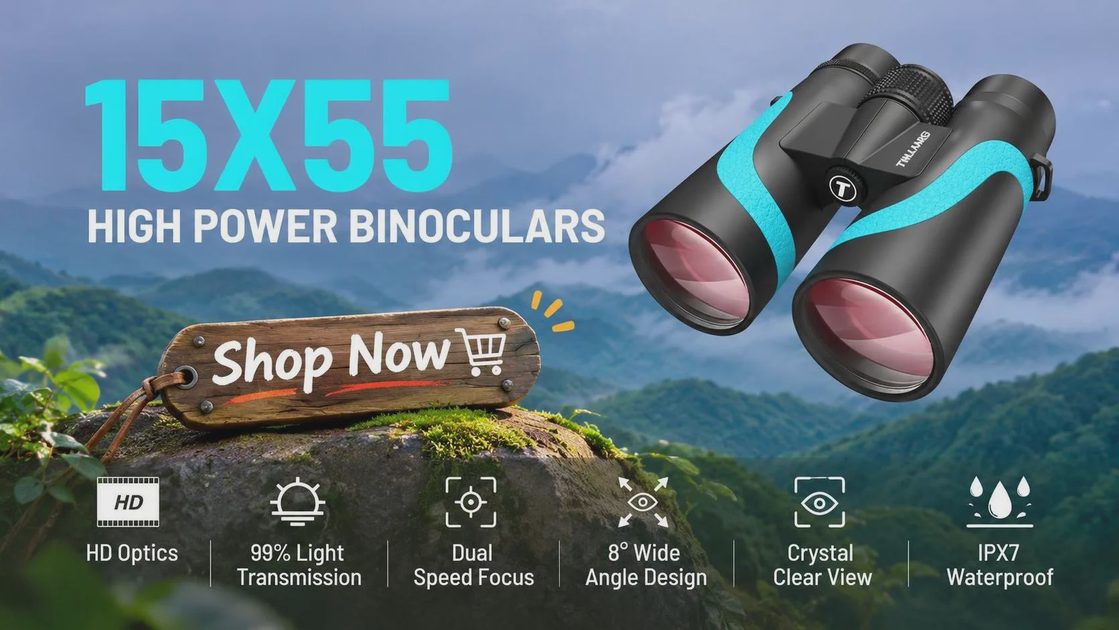
Which is how a pair of 15x55 binoculars with a phone adapter ended up in my bag. The Tinllaans BN06 in blue is a big, high powered, budget-priced pair that promises a lot of reach, and I wanted to see which parts of that promise survive contact with a real hillside. Here's what I found, the good and the annoying.

🏔️ Upgrade Your Weekend Trail Gear
Why I Reached for a Pair of High Powered Binoculars
What 15x and 55mm Tell You Before You Look Through Them
Binocular names are just two numbers. The first is magnification: at 15x, a subject looks fifteen times closer than it does to your bare eye. The second is the objective lens diameter in millimeters, here 55mm, which controls how much light the front glass gathers. Bigger glass usually means a brighter image around dawn and dusk, but also a bigger, heavier body. Divide 55 by 15 and you get the exit pupil, the small bright circle floating in each eyepiece, which comes out around 3.7mm. That's a healthy number for daylight and early evening, and it's the same trade-off I talk about in my lens guides: more reach costs you stability and, eventually, light.
First Impressions Out of the Box
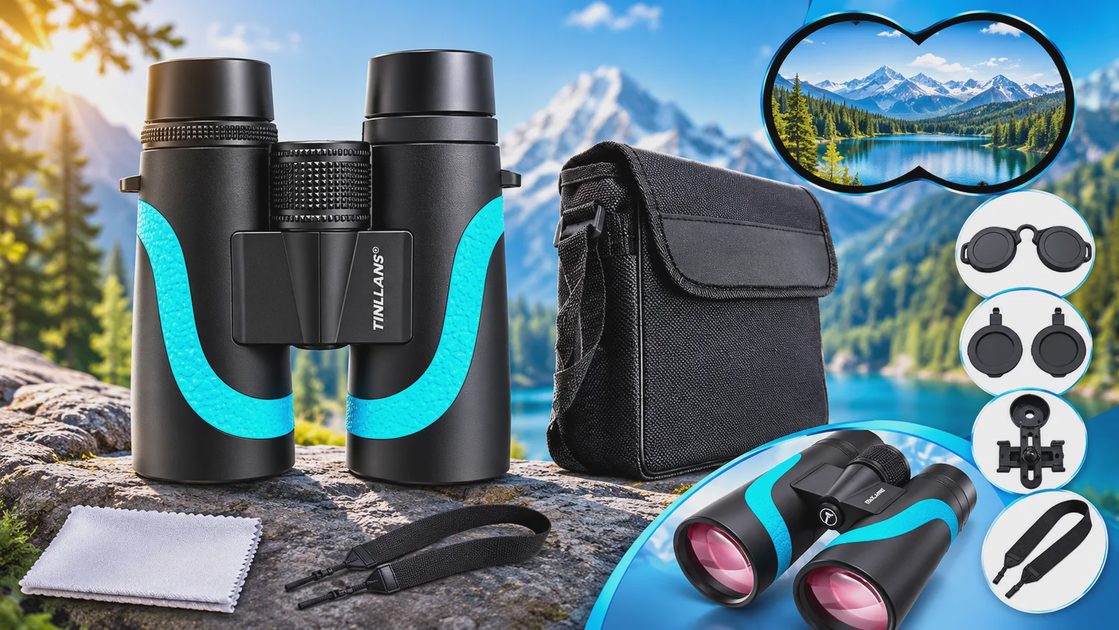
The BN06 looked friendlier in person than I expected. Black barrels, teal rubber panels exactly where your fingers land, and a ribbed focus wheel at the hinge. It reads as a full-size pair, not a toy. The rubber armor gave me a secure grip straight away, which matters more than it sounds when you're holding 15x magnification up to your face. Nothing rattled, nothing felt loose, and the finish looked tidy for the money.
Out in the Field With the Tinllaans 15x55
Reaching Across a Canyon
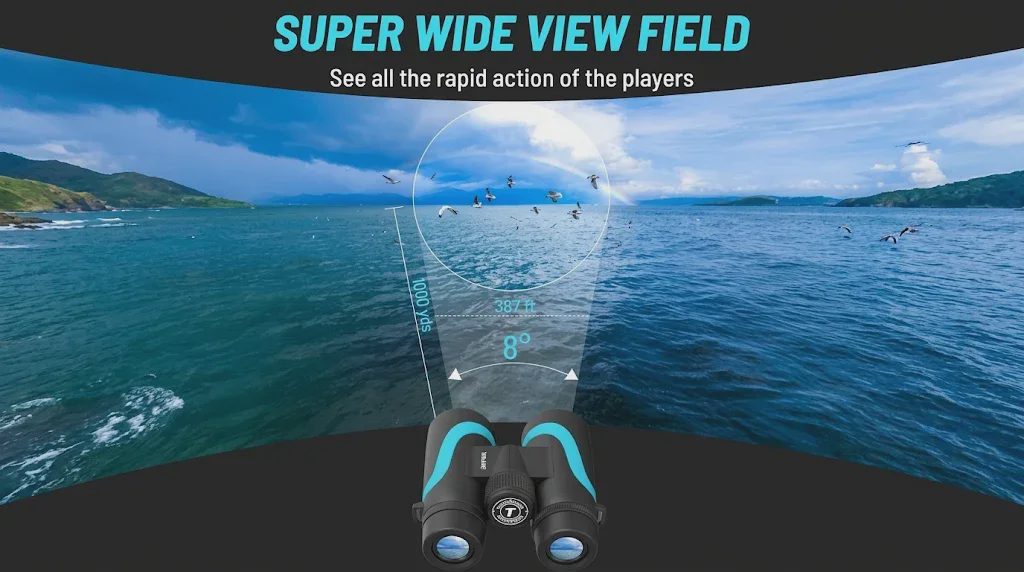
My first real test was a long ridge trail, where I could pick a landmark on the far side of a canyon and compare what the binoculars showed against what my eye (and a 200mm lens) would give me. At 15x, the opposite hillside snapped into a level of detail I'd normally need a telephoto for: individual rock ledges, a fence line I hadn't noticed, a hawk sitting on a dead snag that my naked eye read as a smudge. The listing promises a 367-foot field of view at 1,000 yards, and the view does feel generous for this much magnification. Tracking a moving bird didn't mean losing it every two seconds, which is the usual complaint with high-power pairs.
Focus: Quick to Set, Touchy to Fine-Tune
Focusing is a two-step routine. You set the right eyepiece once for your own eyes, then the center wheel does the rest. I covered the right objective, focused with my left eye, then adjusted the right side until both matched. After that I barely thought about it. Just know that at 15x a tiny turn of the wheel changes a lot, so slow, deliberate movements win. That's not a flaw so much as the nature of the magnification.
The Phone Adapter in Practice
The adapter is what separates this pair from the generic hobby binoculars. The listing describes a five-step installation, and in practice it's a clamp with a tightening knob that sits over one eyepiece. I had my phone lined up within a couple of minutes, and I'll be honest: my first photo was a mess, mostly dark vignette around the edges. After I centered the phone over the eyepiece and nudged the zoom up slightly, a gull perched on a pier railing came out clean enough to share. It won't replace a real camera, but for a quick keepsake it's more fun than I expected.
What Held Up Better Than I Expected
A few things I liked more than I thought I would:
A forgiving view. The wide field makes it easy to find your subject, even if you're a beginner who usually loses the target while raising the binoculars.
Grip and build. The rubberized body feels secure, and it shrugged off a couple of bumps against my backpack straps.
Damp-weather confidence. On a misty morning near the coast, the lenses stayed clear and I didn't have to keep wiping them.
Daylight color. Greens and browns looked natural rather than punched up, which I always prefer.
The Optics, Explained by a Former Sony Engineer
Prisms and Coatings
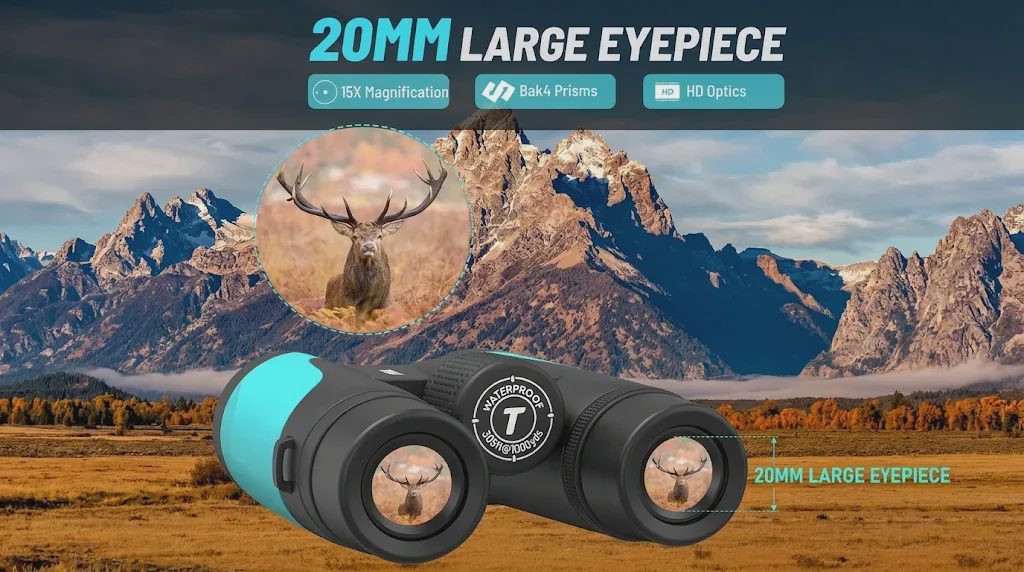
BAK4 is a barium crown glass used in prisms, and it's the one you want at this price tier. Cheaper BK7 prisms tend to leave gray, dim corners because they don't reflect light as cleanly. The listing also says fully multi-coated lenses, meaning every glass surface carries multiple anti-reflective layers, and that's what keeps contrast up and ghosting down when you point toward bright sky. In my use the center of the image was clean with good contrast, while the outer edge was softer, which is exactly what I'd expect at this price. The listing says edge-to-edge sharpness; I'd call it sharp in the middle and perfectly acceptable toward the rim.
Weather: IPX7 and Argon Purging
IPX7 means the housing is rated to survive immersion in up to a meter of water for 30 minutes under test conditions. Argon purging fills the interior with dry gas, so moisture doesn't condense inside the barrels when temperatures swing. For coastal walks and cruise days, both of which the listing mentions, that matters more than any lens spec. I wouldn't toss them into a lake on purpose, but a damp ocean breeze doesn't worry me.
🏔️ Upgrade Your Weekend Trail Gear
What Bugged Me
Handheld Stability at 15x
This is the big one, and it's physics rather than marketing. At 15x, every tiny hand tremor is magnified fifteen times. After a minute or so of continuous viewing, my arms were tired and the image started to drift. Tucking my elbows in, or resting against a post or a car roof, helped a lot. The listing's feature line mentions image stabilization, but I couldn't find anything in the product description that explains an actual stabilization mechanism, so I wouldn't count on it. Treat these as bracing-friendly binoculars.
Weight for a "Lightweight" Pair
Amazon lists the item weight at 1.61 pounds. That's fine for a drive-up overlook, but it isn't featherweight on a long hike. I'd call it moderate: light compared with some other 55mm pairs, noticeable by the end of a day.
Spec Sheet Inconsistencies
A few numbers on the page don't agree with each other, and I'd rather point them out than hide them:
The field of view is listed as 8 degrees, but 367 feet at 1,000 yards works out to roughly 7 degrees.
The specs table says "Water Resistant," while the bullet points claim IPX7 waterproofing.
Light transmission shows up as 99% on one banner and 99.9% on another.
None of that changed what I saw through the glass. It just means the marketing numbers are ballpark, so trust your own eyes. It's also a fixed 15x pair with no zoom, which the listing states plainly.
Phone Adapter Limits
Alignment takes patience, and any small shift brings the vignette right back. Video through the lens at 15x is shaky unless your elbows are braced on something solid. It's a nice extra, not the main event.
Where This Pair Lands for the Money
Who I'd Hand Them To
After a few outings, I'd happily recommend the BN06 to:
Casual bird watchers and hikers who want real reach without a serious optics budget
Travelers and cruise passengers who want a weather-ready pair in the carry-on
Families who like the idea of sharing a view and snapping a phone photo of it
Anyone curious about shooting through binoculars with a phone before committing to more gear
I'd steer these people elsewhere: serious birders who need top-tier edge sharpness, ultralight backpackers counting every ounce, and anyone who wants a zoom.
What I Paid and Why It Felt Fair
When I checked on November 17, the blue pair was listed on Amazon at $33.86, a little under the $35.85 typical price shown on the page, and that's the number I'd anchor on. For 55mm glass, BAK4 prisms and a phone adapter included, it's a low-risk spend, especially when pairs from established optics brands usually cost noticeably more. The page shows a 4.3-star average across 1,259 ratings, 400+ bought in the past month, and a #41 rank in Binoculars, which lines up with my own experience of a solid value pair rather than a flawless one.
It's sold by Tinllaans Direct and shipped by Amazon, so you're going through normal Amazon checkout. One small detail worth knowing: at $33.86 this pair sits just under Amazon's $35 free-shipping line for non-Prime orders, so if you're not a Prime member, you may want to add a small item or two. Amazon also offers an optional protection plan at checkout, a 2-year plan for $3.99 or a 3-year plan for $5.99 at the time I looked. I'd consider it only if these are going to a kid or a clumsy relative.
My Take
I'd rather you buy these for what they are than for what the banner images promise. They're a big, bright, wide-view 15x pair that rewards good technique, and a fun way to try phone digiscoping without spending much. If that sounds like your kind of weekend, you can check the current listing for the Tinllaans 15x55 binoculars on Amazon and compare it against your own list of must-haves.